

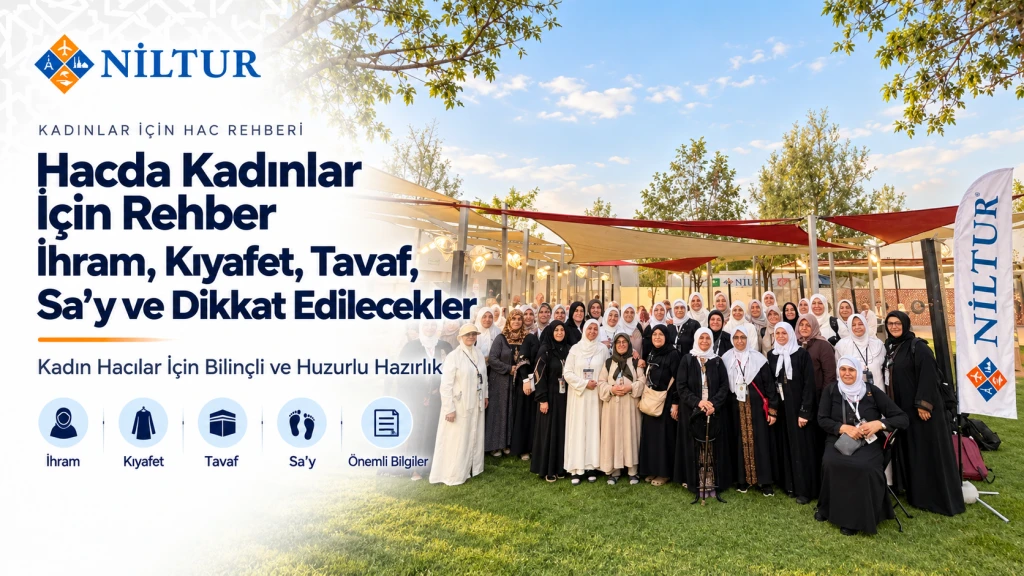
Hajj is a great spiritual journey for all Muslim men and women. Fundamental Hajj rituals such as Ihram, Tawaf, Sa'i, Arafat, Muzdalifah, and Mina are performed by female Hajj candidates with the same consciousness of servitude.
However, there are differences that need to be known regarding the Ihram attire, modesty, personal care, and certain fiqh matters specific to women.
The essence of the Hajj ritual is expressed in the Holy Quran as follows:
"Complete the Hajj and Umrah for Allah."
Surah Al-Baqarah, 2/196
It is important for female Hajj candidates to learn the Hajj rituals before their journey, seek knowledge from competent religious officials about rulings specific to their situation, and prepare physically and spiritually for the trip.
How Do Women Enter Ihram?
Women's Ihram differs from men's Ihram.
While men wear a two-piece Ihram covering for Hajj or Umrah, there is no specific two-piece Ihram garment that women must wear.
A female Hajj candidate:
- In accordance with Islamic modesty (Hijab),
- Comfortable,
- Simple,
- Facilitating movement
can enter Ihram wearing normal clothing.
The true meaning of Ihram is not just about attire; it is a state of worship where one enters into specific prohibitions with the intention of performing Hajj or Umrah.
Must Women's Ihram Attire Be White?
No.
There is no requirement for women to wear white clothing specifically for Ihram.
Simple, inconspicuous, and modest clothing can be chosen.
When choosing attire during Hajj, more importance should be placed on aesthetics than:
- Comfort,
- Mobility,
- Weather conditions,
- Long walks
.
Can Women Cover Their Face While in Ihram?
Different rulings exist regarding the use of face veils and gloves for women compared to men while in the state of Ihram.
In a hadith narrated from Prophet Muhammad (peace be upon him):
"A woman in Ihram should not wear a veil or gloves."
it was stated.
Source: Sahih Al-Bukhari, Hajj
However, there are fiqh details regarding how the face can be protected in situations requiring modesty or when in the presence of non-mahram men. Therefore, it is more correct for female Hajj candidates to learn about this matter in detail from religious officials before traveling.
What Clothing Should Women Prefer During Hajj?
During Hajj, long walks, high temperatures, and crowds should be taken into consideration.
Clothing should be:
- Lightweight,
- Breathable (non-sweaty),
- Comfortable,
- Easy to move in,
- Not too tight,
- In accordance with modesty
.
Packing multiple similar outfits can provide practicality for daily use and cleaning.
Why Are Comfortable Shoes Important for Female Hajj Candidates?
Significant amounts of walking may occur throughout Hajj.
Especially during:
- Tawaf,
- Sa'i,
- Hotel-Haram transport,
- Mina,
- Arafat,
- Muzdalifah
, foot health is of great importance.
Instead of brand new shoes that have not been worn before, options that the feet are accustomed to, comfortable, and suitable for long walks should be preferred.
How Do Women Perform Tawaf?
Women also perform Tawaf by completing seven circuits around the Kaaba.
The basic structure of Tawaf is the same for both women and men.
During crowded periods, it is beneficial for female Hajj candidates to:
- Prefer quieter areas,
- Not force others,
- Not separate from their group without notice,
- Keep their bags as light as possible
.
Tawaf is not a race for speed. The goal is to perform the worship with dignity and tranquility.
Do Women Have to Run Like Men During Tawaf?
Some Tawaf practices specific to men do not apply to women.
Women move at a normal walking pace during Tawaf.
Therefore, instead of trying to move quickly by following others, it is more correct for an individual to walk according to their own physical capacity.
Which Duas Can Be Recited During Tawaf?
There is no obligatory dua text specific to each circuit.
During Tawaf, a female Hajj candidate may:
- Recite duas from the Quran that she knows,
- Seek forgiveness (Istighfar),
- Send blessings upon the Prophet (Salawat),
- Recite Takbir and Tahleel
or make supplication in her own language.
One of the most comprehensive duas mentioned in the Quran is as follows:
"Our Lord! Grant us good in this world and good in the Hereafter, and protect us from the punishment of the Fire."
Surah Al-Baqarah, 2/201
How Do Women Perform Sa'i?
Women also perform the Sa'i ritual, which consists of seven sections between Safa and Marwah.
In the Holy Quran:
"Indeed, Safa and Marwah are among the symbols of Allah."
Surah Al-Baqarah, 2/158
it is stated.
During Sa'i, women are not required to perform the fast-walking practice specific to men. Walking at a normal and safe pace is appropriate.
Can Supplication Be Made During Sa'i?
Yes.
During Sa'i:
- Supplication (Dua),
- Zikr (Remembrance of Allah),
- Salawat,
- Istighfar
can be performed.
It is not obligatory to recite a fixed dua for every round trip.
A Hajj candidate may also make supplication to Allah in their own language.
Why Is Arafat Important for Female Hajj Candidates?
The standing at Arafat (Wuquf) is one of the fundamental pillars of Hajj for all Hajj candidates, both male and female.
The Prophet Muhammad (peace be upon him) said:
"Hajj is Arafat."
He stated.
Source: Tirmidhi, Hajj
On the day of Arafat, it is important for female Hajj candidates to spend time as much as possible with:
- Supplication (Dua),
- Repentance (Tawbah),
- Quran,
- Zikr,
- Reflection (Tafakkur)
.
Is There a Specific Dua Text for Supplication at Arafat?
There is no single mandatory dua text to be recited at Arafat.
An individual may pray for:
- Themselves,
- Their spouse,
- Children,
- Mother and father,
- Deceased loved ones,
- Health,
- Provision (Rizq),
- Spiritual life
.
Arafat is a very special time for a person to turn to Allah in their own language and with sincerity.
What Should Women Pay Attention To in Muzdalifah and Mina?
After Arafat, the process begins in Muzdalifah and then Mina.
This period is one of the busiest parts of Hajj.
For female Hajj candidates:
- Not leaving the group arrangement,
- Saving the guide's phone number,
- Knowing the tent or meeting point,
- Not carrying unnecessary weight,
- Paying attention to water consumption
is important.
The process after Arafat is mentioned in the Holy Quran as follows:
"So depart from the place whence the people depart and ask forgiveness of Allah."
Surah Al-Baqarah, 2/198
Do Women Throw Pebbles at the Jamarat?
Yes. Throwing pebbles at the Jamarat is among the duties of female Hajj candidates within the Hajj rituals.
However, due to the congestion in the Mina area, safety is of great importance.
It is important to move at more suitable times determined by guides, within the limits of the program and fiqh conditions, and not to rush in the crowd.
How Does Hair Cutting Work for Women?
After the relevant rituals of Hajj or Umrah, it is not required for women to shave their heads completely like men.
They shorten a small amount of their hair in accordance with fiqh measurements.
The timing and method of this procedure should be done under the guidance of religious officials, depending on the type of Hajj.
Does a Woman's Special Condition Affect Hajj Worship?
A woman's menstrual or postpartum periods may affect the timing of the performance of some rituals during Hajj.
In authentic hadiths, it is recorded that when Hazrat Aisha entered her menstruation during her Hajj journey, the Prophet Muhammad (peace be upon him) told her:
"Perform everything that the pilgrims do, except that you should not circumambulate the Kaaba until you become pure."
He said.
Source: Sahih Al-Bukhari and Sahih Muslim
This hadith shows that the Hajj process does not completely end for women in their special condition; however, there are different rulings especially regarding Tawaf.
If this situation arises, it is the most correct approach for the person not to decide on their own but to consult the group's religious official.
Can One Go Up to Arafat During Menstruation?
Yes. A woman's special condition is not an obstacle to the standing at Arafat.
A female Hajj candidate:
- Can continue the standing at Arafat,
- Zikr,
- Supplication (Dua),
- The processes of Muzdalifah and Mina
according to the schedule.
In rituals with special rulings, such as Tawaf, the guidance of religious officials should be followed.
Should Medication Be Used for Menstrual Cycle Management Before Hajj?
Some women may consider using medication to change their menstrual dates during the Hajj season.
Since this topic varies from person to person, medication should not be used without a doctor's evaluation.
The medication to be used:
- Should be evaluated based on the person's health status,
- Age,
- Other medications they take,
- Risk factors
.
Consulting with a gynecologist weeks before Hajj may be a safer approach.
How Can Women Protect Their Modesty During Hajj?
Due to crowded environments, preparation in advance regarding modesty is beneficial.
When choosing clothing:
- Products that are not easily opened,
- Comfortable,
- Do not cause problems during long walks,
- Do not reveal the body
can be preferred.
Adhering to group arrangements in hotels, tents, and common areas is also important for modesty.
Should Women Move Alone During Hajj?
Especially in very crowded areas, it is recommended not to leave the group arrangement as much as possible.
Even if there is time for individual worship in Mecca and Medina:
- The location of the hotel,
- Meeting point,
- Group guide's phone number,
- Return route
should be known.
In areas such as Arafat, Mina, and Muzdalifah, adhering to the group program is even more important.
What Should a Bag Look Like for Female Hajj Candidates?
Large and heavy bags can be tiring during long walks.
In a small shoulder or waist bag:
- Hotel card,
- Group information,
- Phone,
- Small power bank,
- Necessary personal items,
- Regularly used medications
can be kept.
Guidelines from the organization regarding how to carry important documents like passports should be followed.
What Should Be Considered Regarding Personal Care Products?
Due to Ihram restrictions, special caution should be exercised regarding products containing scents.
When selecting items needed before Hajj:
- Personal hygiene products,
- Hygiene products,
- Wet wipes,
- Sunscreen,
- Skin care products
, information should be obtained regarding whether they can be used during the Ihram process.
If necessary, scent-free products can be preferred.
Physical Preparation for Women During Hajj
Walking regularly before going to Hajj is also important for female Hajj candidates.
Especially:
- Tawaf,
- Sa'i,
- Mina,
- Muzdalifah,
- Daily Haram transport
may require significant movement.
Gaining a habit of walking suitable for the person's age and health condition can provide an advantage during the trip.
What Should Elderly Female Hajj Candidates Pay Attention To?
Women participating in Hajj at an advanced age should evaluate issues such as:
- Hotels at close distance,
- More comfortable room arrangements,
- Elevator access,
- Group support,
- Regular medication use
in their program selection.
Individuals with chronic diseases must consult their own physicians before traveling.
Patience and Good Character During Hajj
Without distinction between men and women, one of the most important spiritual preparations during Hajj is patience.
In the Holy Quran:
"Whoever intends to perform Hajj in these months should not have sexual relations, commit sin, or argue during Hajj."
Surah Al-Baqarah, 2/197
it is stated.
Controlling anger in the face of crowds, heat, or waiting is an important part of Hajj ethics.
Cooperation During Hajj
Female Hajj candidates can help other guests in the same group who are:
- Elderly,
- Traveling alone,
- Limited in mobility
.
Hajj is a great gathering of brotherhood where Muslims from different parts of the world come together for the same purpose.
In the Holy Quran:
"And cooperate in righteousness and piety."
Surah Al-Ma'idah, 5/2
it is stated.
This principle can be lived out concretely in the Hajj environment.
Intention and Avoiding Ostentation During Hajj
Sincerity is the foundation of the Hajj ritual.
In the famous hadith of the Prophet Muhammad (peace be upon him):
"Actions are judged by intentions."
it was stated.
Source: Sahih Al-Bukhari and Sahih Muslim
Although taking photos or collecting memories from the trip is possible, being careful that the worship does not turn into social media sharing is important for preserving one's own intention.
Packing List for Women for Hajj
The following items may be included in the Hajj suitcase according to personal needs:
- Comfortable and simple clothing
- Headscarves
- Comfortable walking shoes
- Slippers
- Socks
- Scent-free personal care products
- Hygiene products
- Regularly used medications
- Small shoulder bag
- Phone charger
- Power bank
- Thin jacket suitable for the season
Filling the suitcase more than necessary provides significant ease throughout the long journey.
Spiritual Preparation for Female Hajj Candidates
The most important preparation for Hajj is the preparation of the heart.
The Holy Quran says for this journey:
"Take provision, but indeed, the best provision is taqwa (piety)."
Surah Al-Baqarah, 2/197
it states.
Before Hajj:
- Repenting (Tawbah),
- Seeking reconciliation,
- Preparing a list of duas,
- Learning Hajj rituals,
- Reading Hajj verses from the Quran,
- Preparing for patience
are important parts of spiritual preparation.
Guidance for Female Hajj Candidates with Niltur
In the Hajj journey, it is important for female Hajj candidates to reach correct guidance regarding operational needs as well as special situations they may encounter during worship.
Niltur, with over 30 years of Hajj organization experience, aims to plan group coordination and guidance services comprehensively in the processes of Mecca, Medina, Arafat, Mina, and Muzdalifah.
Enabling Hajj candidates to easily consult competent religious officials on their specific fiqh matters contributes to a more conscious and peaceful journey.
Frequently Asked Questions
What do women wear during Hajj?
Women do not have a specific two-piece Ihram garment like men. They can enter Ihram with simple and comfortable clothing that conforms to modesty.
Must women's Ihram attire be white?
No. It is not mandatory for women to wear white for their Ihram attire.
Do women perform Tawaf?
Yes. Women also perform Tawaf by completing seven circuits around the Kaaba.
Do women perform Sa'i?
Yes. Sa'i between Safa and Marwah is an important stage of Hajj and Umrah rituals.
Do women run during Sa'i?
The fast-movement practice specific to men is not expected from women. Women can perform Sa'i at a normal walking pace.
Do women participate in the Arafat standing?
Yes. The standing at Arafat is one of the fundamental pillars of Hajj for all Hajj candidates, both male and female.
Does a woman's special condition prevent her from performing Hajj?
No. Not all stages of Hajj end; however, there are special rulings especially regarding Tawaf. In such cases, the guidance of a competent religious official should be followed.
Can women wear a veil while in Ihram?
Authentic hadiths indicate that a woman in Ihram should not wear a veil or gloves. For detailed applications regarding modesty, consulting a religious official is appropriate.
Can women make duas in Turkish during Hajj?
Yes. Besides the duas in the Quran and Sunnah, they can also make sincere supplications in their own languages.
What is the most important preparation for women during Hajj?
Learning the Hajj rituals, preparing physically for walking, planning health needs, and making spiritual preparation are the most important points.
Note: Women's special conditions, Ihram restrictions, and some fiqh details of the Hajj rituals may vary according to schools of thought and the individual's situation. In practice, the guidance of competent religious officials and official Hajj guides should be followed.