

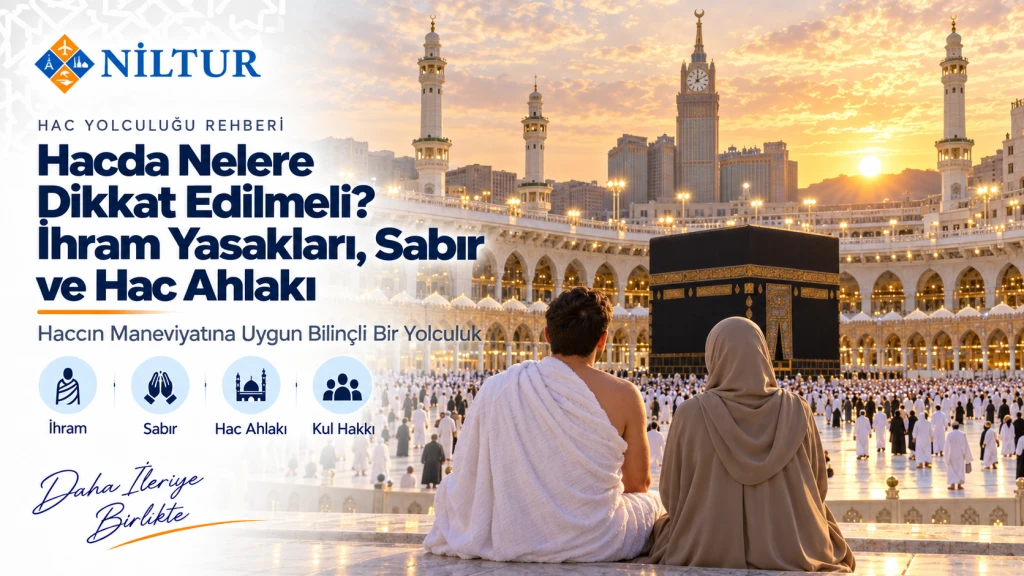
Hajj is not merely about performing specific acts of worship in certain places. It is also a worship where patience, good character, brotherhood, respecting the rights of others, and consciousness of submission to Allah are strongly lived.
The Quran-ı Kerim, when explaining the Hajj worship, also draws attention to the behavior of Hajj candidates:
"Whoever enters Ihram for Hajj with the intention during these months, then there is no sexual relations, sinning, or arguing during Hajj."
Surah Al-Baqarah, 2/197
This verse shows that Hajj is completed not only by the acts performed but also by avoiding certain behaviors.
It is important for the Hajj candidate to know the rules of Ihram as well as being patient in crowds, considering the rights of others, avoiding arguments, and preserving the spiritual atmosphere of the worship.
What Should Be Payed Attention to Most During Hajj?
The following are among the main points to be considered during the Hajj process:
- Learning the prohibitions of Ihram
- Adhering to the times of Hajj rituals
- Avoiding arguments and bad words
- Respecting the rights of others
- Behaving patiently in crowds
- Not leaving the group arrangement
- Using physical strength correctly
- Paying attention to water consumption and rest
- Performing Hajj rituals consciously
Considering the intensity of the Hajj journey, even seemingly small behaviors can affect both the individual's and other pilgrims' worship.
What Are the Prohibitions of Ihram?
Ihram is a special state of worship entered upon intending to perform Hajj or Umrah.
Along with entering Ihram, the Hajj candidate must temporarily refrain from certain behaviors that are permissible in normal times.
Certain rulings regarding the state of Ihram are explicitly mentioned in the Quran-ı Kerim. For example:
"O you who have believed! Do not kill game while you are in the state of Ihram."
Surah Al-Ma'idah, 5/95
Since the details of Ihram prohibitions may vary between men and women, it is important to learn this matter in detail from competent religious officials before Hajj.
What Should Be Paid Attention to While in Ihram?
Generally, a person in the state of Ihram must pay attention to:
- Not removing hair or shaving,
- Not cutting nails,
- Rules regarding the use of perfume and pleasant scents,
- The prohibition of hunting,
- Specific prohibitions between spouses,
- Men's specific Ihram dress codes
Since fiqh details may vary according to an individual's situation and school of thought (madhab), consulting a religious official rather than making a ruling on one's own in case of accidental violation is the most sound method.
Why Should One Avoid Fighting and Arguments During Hajj?
The presence of millions of people in the same place during Hajj can sometimes cause challenging situations.
Long waits, heat, traffic congestion, and crowds can test a person's patience.
However, the Quran presents a morality that explicitly forbids arguing during Hajj:
"...There is no sexual relations, sinning, or arguing during Hajj."
Surah Al-Baqarah, 2/197
Therefore, for a Hajj candidate, it is more valuable not to be able to win an argument than to win it; rather, it is to avoid the argument altogether.
Why Is Patience Important During Hajj?
Patience is one of the most needed characteristics during the Hajj journey.
The Hajj candidate:
- Might have to wait while waiting for a bus,
- While eating,
- In elevators,
- During Tawaf,
- During Sa'i,
- During transitions between Arafat, Mina, and Muzdalifah,
- At hotel entrances and exits
might have to wait or face crowds.
It is beneficial to evaluate these processes not just as difficulties but as part of the spiritual education of Hajj.
The Prophet Muhammad (PBUH) Advised Calmness During Hajj
In authentic narrations, it is recorded that when the Prophet Muhammad (PBUH) saw people rushing when leaving Arafat, he called them to remain calm.
This Sunnah is extremely meaningful today as well.
During Hajj:
- Rushing,
- Pushing people,
- Trying to get ahead of the group,
- Forcing through crowds
acting with calmness is more appropriate for both the spirit of the worship and safety.
Respecting the Rights of Others During Hajj
Hajj is a worship that requires a person to review not only their relationship with Allah but also their relationships with other people.
Within the crowd:
- Jumping someone else's line,
- Pushing people,
- Unnecessarily occupying common areas,
- Disturbing others with loud voices,
- Keeping group members waiting
are behaviors that should be evaluated in terms of the rights of others and good character.
One of the spiritual gains of Hajj is that a person becomes more sensitive towards the rights of others.
The Relationship Between Accepted Hajj and Good Character
The Prophet Muhammad (PBUH) said:
"Whoever performs Hajj for the sake of Allah and does not commit any obscenity or sin will return [free from sins] as on the day his mother gave birth to him."
Source: Sahih Al-Bukhari
One of the notable points in this Hadith is that the virtue of Hajj is mentioned alongside refraining from bad words and sins.
Therefore, it is an important part of the spiritual aspect of the worship for a person to control:
- Their tongue,
- Their anger,
- Their behavior,
- And their relationships with people
during Hajj.
Avoiding Bad Words During Hajj
Disagreements can sometimes occur in environments with high human density.
However, a Hajj candidate:
- Should not insult,
- Should not shout,
- Should not gossip,
- Should not belittle people,
- Should not speak hurtfully
is required.
Returning with good character after Hajj is one of the important indicators that the worship has been reflected in life.
What Should Be Paid Attention to During Tawaf?
Tawaf is one of the most special rituals of Hajj, and during peak periods, Masjid al-Haram can be very crowded.
During Tawaf:
- Not pushing people,
- Not disrupting the flow in the opposite direction,
- Not trying to keep the entire group walking side by side,
- Not disturbing the surroundings by making collective supplications loudly,
- Carefully tracking the number of rounds
is important.
When it is not possible to approach Hajar al-Aswad due to crowds, one should not try to advance at the expense of harming others.
Is It Correct to Force People to Touch Hajar al-Aswad?
The area where Hajar al-Aswad is located can be extremely crowded, especially during the Hajj season.
It is not correct to harm another Muslim while trying to fulfill a Sunnah.
Therefore, if a person cannot reach it, they should not force the crowd, push others, and continue their worship with calmness.
What Should Be Paid Attention to During Sa'i?
Sa'i between Safa and Marwa is also a worship requiring intense walking.
During Sa'i:
- Adjusting the walking pace according to physical capacity,
- Avoiding unnecessary rushing,
- Not blocking others' passage,
- Paying attention to water consumption,
- Helping elderly and those with limited mobility
is important.
The purpose of Sa'i is not to race but to perform the worship consciously.
What Should Be Paid Attention to in Arafat?
Arafat is one of the most important stages of the Hajj worship.
The Prophet Muhammad (PBUH):
"Hajj is Arafat."
said.
Source: Tirmidhi, Hajj
On the day of Arafat, as much as possible:
- Supplication (Dua),
- Repentance (Tawbah),
- Remembrance of Allah (Zikr),
- Quran recitation,
- Reflection (Tafakkur)
should be utilized.
It is beneficial for a person to utilize this special time spiritually rather than spending it with unnecessary conversations, phones, or other distractions.
Is It Correct to Leave the Group in Arafat?
Especially the transition from Arafat to Muzdalifah can be very crowded.
A Hajj candidate moving independently and leaving the group:
- Can lead to getting lost,
- Missing transportation,
- Disrupting the group arrangement
can happen.
It is important to adhere to the movement times and meeting points set by the guides.
What Should Be Paid Attention to in Muzdalifah?
In the Quran-ı Kerim:
"Then depart from the place from where [all] the people depart and ask forgiveness of Allah. Indeed, Allah is Forgiving and Merciful."
Surah Al-Baqarah, 2/198
is stated.
(Note: The translation reflects the context of the Turkish text provided which quotes "Arafat'tan ayrılıp akın ettiğinizde Meş’ar-i Haram’da Allah’ı zikredin" - Then when you depart from Arafat, remember Allah at Al-Mash'ar al-Haram).
In Muzdalifah, Hajj candidates must spend their time in supplication and remembrance, and also follow the guide program for the transfer to Mina.
It is especially important not to leave the group arrangement at this stage where attention may decrease due to fatigue.
What Should Be Paid Attention to in Mina?
Mina is one of the most crowded areas during the Hajj season.
Here:
- Learning the tent location,
- Recording group numbers,
- Having the guide's phone nearby,
- Tracking the departure times for Jamrat,
- Not creating unnecessary crowds
is important.
Especially in areas where tents look similar, recording location information can be beneficial.
What Should Be Paid Attention to During Stoning of the Jamarat?
Safety and calm movement are important when throwing stones at the Jamarat.
Hajj candidates:
- Must move at designated times,
- Must not leave their group,
- Must not rush,
- Must not push others,
- Must follow the guides' directions
are required.
The spiritual meaning of the worship does not align with acting out of anger or in a way that harms others.
Does Taking Too Many Photos and Videos During Hajj Affect the Worship?
Using a phone is not contrary to the Hajj worship on its own. However, constantly taking photos and videos in holy places can reduce a person's focus on worship.
Especially:
- During Tawaf,
- In Arafat,
- During Dua,
- In Masjid al-Haram,
- In Masjid an-Nabawi
it is beneficial to use the phone in moderation.
The goal of Hajj is not just to collect memories, but even more importantly, to experience a spiritual transformation.
Moderation in Social Media Use During Hajj
Sharing photos from Hajj is possible; however, it is important for the person to review their own intention regarding the worship not turning into showing off.
The Hadith of the Prophet Muhammad (PBUH):
"Actions are judged by intentions."
is an important measure at this point.
Source: Sahih Al-Bukhari and Sahih Muslim
A person should not forget that their worship is for the pleasure of Allah.
Avoiding Waste During Hajj
It is important to be moderate in shopping, eating, and personal needs during Hajj.
In the Quran:
"Eat and drink, but do not be excessive. Indeed, He likes not those who commit excess."
Surah Al-A'raf, 7/31
is stated.
Especially taking more food than needed at buffets and then throwing it away is a behavior that should be avoided both morally and from an Islamic perspective.
Avoiding Waste When Using Zamzam Water
Zamzam water is one of the important blessings of the holy lands.
Not wasting unnecessarily while drinking or carrying it is a sign of respect for the blessing.
One of the fundamental teachings of Hajj is to better understand the value of blessings.
Why Is Cleanliness Important During Hajj?
Cleanliness is important both religiously and socially during the Hajj season when millions of people are in the same area.
Hajj candidates:
- Must dispose of their trash in designated areas,
- Must keep common usage areas clean,
- Must pay attention to personal hygiene,
- Must respect the living spaces of other pilgrims
are required.
Cleanliness is important not only for a person's own comfort but also for the health of other pilgrims.
Not Neglecting Health During Hajj
Focusing on worship does not mean completely ignoring health needs.
Especially during hot periods:
- Drinking enough water,
- Resting,
- Not staying unnecessarily in the sun,
- Not skipping regular medications,
- Not overexerting physical limits
is important.
Protecting health helps in performing the worship sustainably.
Why Is Group Arrangement Important During Hajj?
Moving individually during Hajj can cause serious problems in some cases.
Especially:
- In Arafat,
- In Muzdalifah,
- In Mina,
- At airports,
- Hotel transfers
the group program must be followed.
A delay by one person can affect not only themselves but the entire group's schedule.
Therefore, punctuality can be seen as a practical part of Hajj etiquette.
Helping Elderly Pilgrims
There may be many elderly guests or those with limited mobility during Hajj.
Giving them:
- The right of way,
- Help carrying their luggage,
- Priority in elevators,
- Directions when necessary
are beautiful examples of Islamic brotherhood.
One of the most important changes expected from Hajj on a person is the strengthening of feelings of mercy and mutual assistance.
Being Tolerant Towards Different Cultures
Hajj is a unique worship where Muslims from almost every region of the world come together.
People:
- May have different languages,
- Cultures,
- Dress styles,
- Daily habits
may differ.
Instead of criticizing these differences, seeing the diversity of the Ummah provides a better understanding of the brotherhood dimension of Hajj.
In the Quran-ı Kerim, it is stated that people were created as nations and tribes so that they may know one another:
"O mankind, indeed We have created you from male and female and made you peoples and tribes that you may know one another."
Surah Al-Hujurat, 49/13
Focus on Your Own Worship Instead of Criticizing Others During Hajj
Differences may be observed in how people perform their worship or their habits during Hajj.
Due to madhab differences and different cultural practices, everyone may not act in the same way.
It is a healthier approach for a Hajj candidate to focus on their own servitude, prayer, and character rather than constantly evaluating the worship of others.
If there is doubt about a fiqh matter, a competent religious official should be consulted.
Shopping During Hajj Should Be Moderate
There are numerous shopping opportunities in Mecca and Medina.
Buying souvenirs is natural, but it is important that shopping:
- Does not interfere with prayers,
- Does not interfere with visits,
- Does not interfere with prayer times,
- Does not disrupt the group program
reaches such a scale.
The main goal of the Hajj journey is not shopping but worship.
Do Not Rush During Hajj
One of the most important practical advices during Hajj is not to rush.
Trying to get ahead by a few minutes by forcing people, exhausting the body excessively to perform more worship in a short time, or moving outside the program can often create more problems than benefits.
The practice of the Prophet Muhammad (PBUH) advising calmness during Hajj is an important example in this regard.
Do Not Compare Yourself With Others During Hajj
Every Hajj candidate:
- Has a different age,
- Health status,
- Physical capacity,
- Worship knowledge
is not the same.
It may not be possible for everyone to perform additional worship at the same intensity as another person.
It is important for a person to perform worship according to their own strength without risking their health.
Constantly Remembering Your Intention During Hajj
Operational details during Hajj can sometimes cause a person to forget their main purpose.
When facing issues with hotels, meals, rooms, transportation, or waiting, a person can remind themselves of the following question:
"Why did I embark on this journey?"
At the center of Hajj is the pleasure of Allah and servitude.
In the Quran-ı Kerim:
"And complete the Hajj and 'Umrah for Allah."
Surah Al-Baqarah, 2/196
is stated, reminding this intention strongly.
This Sensitivity Should Continue Even After Hajj
The effect of Hajj should not be limited to the days spent in the holy lands.
After returning, the Hajj candidate should also try to live a life that is:
- More patient,
- More merciful,
- More sensitive to the rights of others,
- More regular in worship,
- Further away from bad words
to continue the spiritual gains of Hajj.
The glad tidings of the Prophet Muhammad (PBUH):
"The reward for an accepted Hajj is nothing but Paradise."
also reminds the goal that Hajj is not just physically completed but transformed into an accepted worship.
Source: Sahih Al-Bukhari and Sahih Muslim
Guidance on the Hajj Journey with Niltur
Correct guidance on the Hajj journey is not just about showing which bus to board.
From Ihram to Arafat, from Mina to Muzdalifah, from Tawaf to Sa'i, both worship knowledge and group organization are important at every stage.
Niltur, with over 30 years of Hajj organization experience, aims to plan operational processes in the holy lands in a planned manner; and to support Hajj candidates to focus more on the spiritual aspect of their journey.
Frequently Asked Questions
What should be paid attention to most during Hajj?
Attention should be paid to Ihram rules, the timing of rituals, the rights of others, patience, group arrangement, and good character.
What is forbidden while in Ihram?
While in the state of Ihram, cutting hair and nails, using certain scented products, hunting, and other Ihram-specific prohibitions exist. Details should be learned from religious officials before Hajj.
Why is fighting specifically forbidden during Hajj?
Verse 197 of Surah Al-Baqarah explicitly commands avoiding arguments and sinful behavior during Hajj.
Is touching Hajar al-Aswad mandatory?
No. If reaching it is not possible due to crowds, it is not correct to force people or cause harm.
Can one make dua in Turkish during Hajj?
Yes. A Hajj candidate can make sincere supplications in their own language.
Is using a phone and taking photos forbidden during Hajj?
Generally, phone use is not a prohibition of the worship. However, care should be taken that constantly taking photos and videos does not reduce worship concentration.
Can one shop during Hajj?
Yes; however, it is appropriate that shopping does not reach a scale that disrupts worship or the group program.
Is it problematic to leave the group during Hajj?
Especially in crowded areas like Arafat, Muzdalifah, and Mina, leaving the group can lead to getting lost and transportation issues. Adhering to the guides' program is important.
What is one of the most important moral messages of Hajj?
Patience, piety, respecting the rights of others, and good character are among the core spiritual messages of Hajj.
Note: Ihram prohibitions and fiqh details of Hajj rituals may vary according to schools of thought and an individual's situation. In practice, the directives of competent religious officials and official Hajj guidance should be followed.