

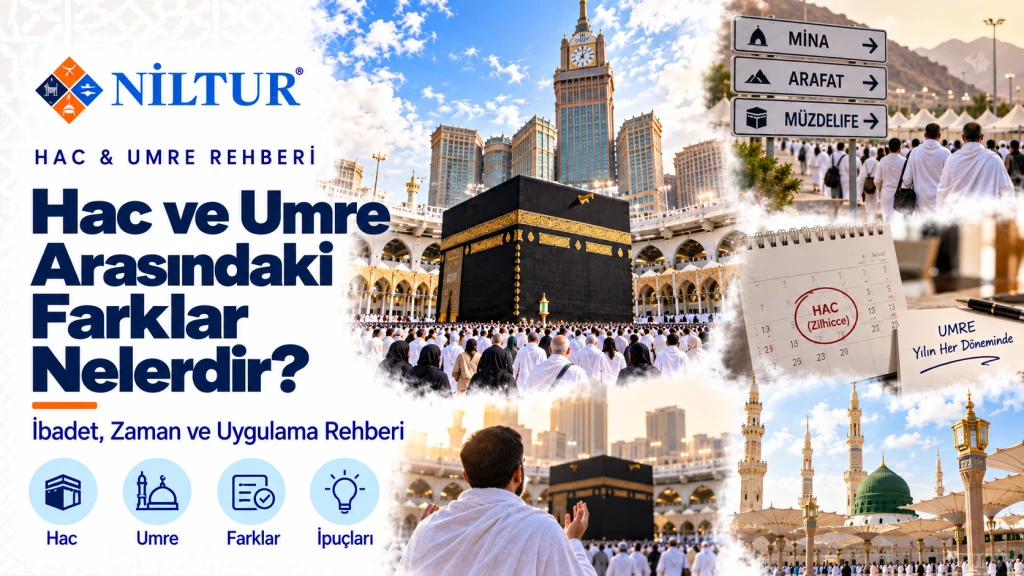
Hajj and Umrah are among the most important spiritual journeys in the Islamic world. In both, Mecca is visited, one enters ihram, circumambulates the Kaaba, and performs various acts of worship. However, Hajj and Umrah are not the same act of worship.
There are significant differences in terms of timing, implementation, duration, and the acts of worship performed.
In particular, one of the most frequently asked questions by those planning to travel to the holy lands for the first time is "What is the difference between Hajj and Umrah?".
What is Hajj?
Hajj is one of the five fundamental pillars of Islam.
It is a mandatory act of worship that Muslims who meet the necessary financial and physical conditions must perform once in their lifetime.
Hajj is performed on specific days determined in the Islamic calendar and consists of more than just circumambulation (Tawaf) in Mecca.
Among the important stages of the Hajj ritual:
- Ihram
- Standing at Arafat
- Muzdalifah
- Mina
- Stoning the Jamarat
- Tawaf
- Sa'i
- Sacrifice and shaving
are included.
What is Umrah?
Umrah is an act of worship completed by entering ihram, circumambulating the Kaaba, performing Sa'i between Safa and Marwa, and then shaving or trimming one's hair.
Unlike Hajj, Umrah is not tied to specific days.
It can be performed during most of the year. However, seasonal practices regarding travel and worship, as well as Saudi Arabia's current regulations, should be taken into account.
What is the Most Fundamental Difference Between Hajj and Umrah?
The most fundamental difference is that Hajj is performed at a specific time with more comprehensive rituals, while Umrah can be performed over a wider time frame throughout the year.
During Hajj, there are acts of worship performed at holy sites such as Arafat, Mina, and Muzdalifah, whereas these stages do not exist in Umrah.
Comparison of Hajj and Umrah
TopicHajjUmrahTime | During specific Hajj days | Most of the year |
Standing at Arafat | Yes | No |
Mina | Part of the Hajj program | Not part of Umrah |
Muzdalifah | Yes | No |
Stoning the Jamarat | Yes | No |
Tawaf | Yes | Yes |
Sa'i | Yes | Yes |
Ihram | Yes | Yes |
Program Structure | More comprehensive | Can be shorter and more flexible |
Intensity | Very high during Hajj season | Varies by period |
When is Hajj Performed?
The Hajj ritual is performed on specific days in the month of Dhul-Hijjah according to the Hijri calendar.
Therefore, the timing of the Hajj journey cannot be changed throughout the year according to the pilgrim's wish.
Hajj organizations are carried out based on specific dates, quotas, and official regulations.
When is Umrah Performed?
Umrah is more flexible in terms of dates compared to Hajj.
During different periods of the year:
- School holidays
- Ramadan
- Religious nights (Kandil)
- Spring
- Autumn
- Winter months
Umrah programs can be organized at different times.
This flexibility may allow Umrah to be organized more easily according to work and leave plans.
Why is Arafat Included in Hajj but Not in Umrah?
The standing at Arafat is one of the fundamental pillars of Hajj.
During the Hajj season, pilgrims stand in the Arafat region at the designated time and perform the standing.
In the Umrah ritual, however, the standing at Arafat is not present.
This is one of the most important differences in acts of worship between Hajj and Umrah.
Are Mina and Muzdalifah Part of Umrah?
No. Mina and Muzdalifah are important stages of the Hajj ritual.
During Hajj, pilgrims move from Arafat to Muzdalifah, and then to Mina.
In the Umrah ritual, this process does not need to be performed.
Is Stoning the Devil Present in Umrah?
No.
Stoning the Jamarat is an act of worship performed in Mina on specific days of the Hajj ritual.
There is no stoning of the devil in Umrah.
Is Tawaf the Same in Hajj and Umrah?
Both in Hajj and Umrah, the Kaaba is circumambulated, but the position and types of Tawaf within the worship may differ.
In Umrah, primarily the Umrah Tawaf is performed, whereas during the Hajj process, different Tawafs can be performed at different times.
Therefore, the application of the Hajj ritual is more comprehensive than Umrah.
Is Sa'i Performed in Hajj and Umrah?
Yes. Sa'i can be performed between Safa and Marwa in both rituals.
Sa'i is an act of worship performed properly between Safa and Marwa.
It is beneficial for guests visiting the holy lands for the first time to consider that Sa'i involves a significant amount of walking.
Is Ihram Required in Hajj and Umrah?
Yes. One enters ihram for both Hajj and Umrah.
Ihram does not only mean the two-piece garment worn by men. It also refers to the state of worship entered with specific intentions and rules.
Certain prohibitions must be observed after entering ihram.
How Many Days Do Hajj and Umrah Take?
Umrah programs can be prepared with varying durations.
For example:
- 7 nights 8 days
- 9 nights 10 days
- 13 nights 14 days
such Umrah programs are available.
Hajj, on the other hand, requires a more comprehensive travel organization because it covers specific Hajj days and includes stages such as Arafat, Mina, and Muzdalifah.
The total duration of the Hajj program may vary depending on the selected package.
Is Hajj More Intense Than Umrah?
Hajj is generally a much more intense organization in terms of the scope of rituals and the number of people present in the holy lands during the same period.
During the Hajj season:
- Arafat
- Muzdalifah
- Mina
- Al-Masjid al-Haram
there is very heavy human movement around these areas.
In Umrah, the intensity varies depending on the travel period. Especially during Ramadan and holiday seasons, Umrah crowds can increase significantly.
Does Hajj Require More Physical Preparation Than Umrah?
Both rituals involve walking and physical exertion.
However, during Hajj, movement between different holy sites and the performance of rituals within specific time frames may result in higher physical intensity.
Those going to Hajj would benefit from regular walking before the trip and evaluating their physical condition.
In Umrah, too, one must be prepared for walking due to Tawaf, Sa'i, and daily movements around the Haram.
Is There a Visit to Medina in Hajj and Umrah?
Medina visits can be included in both Hajj and Umrah programs.
In Medina:
- Al-Masjid an-Nabawi
- Uhud area
- Quba Mosque
- Other historical and religious visit sites
can be visited as part of the program.
While the visit to Medina is separate from the core elements of the Hajj or Umrah rituals performed in Mecca, it constitutes an important part of travels to the holy lands.
The Importance of Accommodation in Mecca for Hajj and Umrah
In both programs, the location of the hotel in Mecca is important for the daily worship routine.
Nearby accommodation to Al-Masjid al-Haram:
- May reduce daily walking time
- May provide easier access to the Haram
- May facilitate efficient use of time between worship and rest
For elderly guests especially, hotel location is an important selection criterion.
Is There a Difference Between Near-Distance Hajj and Near-Distance Umrah?
In both programs, the term "near-distance" primarily refers to accommodation options with easy access to Al-Masjid al-Haram.
However, due to the extraordinary intensity during the Hajj season, the advantage of a near-distance hotel may become more pronounced.
In Umrah, a nearby hotel provides significant comfort especially for short programs, elderly travelers, and families with children.
Why Are Hajj and Umrah Prices Different?
The scope of Hajj and Umrah organizations differs from each other.
In Hajj programs:
- Obligation of specific periods
- High demand for accommodation
- Additional operations at holy sites
- Processes at Arafat, Mina, and Muzdalifah
- More comprehensive transport and group organization
are present.
Therefore, it is not correct to directly compare Hajj and Umrah prices like the same package.
In Umrah prices, program duration, hotel, flight date, room type, and travel season may be more determining factors.
Is It Necessary to Perform Umrah Before Hajj?
Having performed Umrah before Hajj is not a prerequisite for going to Hajj.
However, having previously performed Umrah:
- Helps familiarize oneself with the atmosphere of Mecca and Medina
- Gains experience regarding ihram
- Learns Tawaf and Sa'i
- Adapts to the travel arrangement in the holy lands
may personally be beneficial.
This situation should not be considered as one of the conditions of the Hajj obligation.
Does Performing Umrah Replace Hajj?
No.
Hajj and Umrah are different acts of worship. Performing Umrah does not fulfill the Hajj obligation for a person upon whom Hajj is mandatory.
Hajj has its own specific time, conditions, and rituals.
Can a Person Who Has Performed Hajj Go for Umrah?
Yes. Having previously performed Hajj does not prevent the performance of the Umrah ritual later.
Many people may join Umrah programs to visit the holy lands again at different times after Hajj.
Is Umrah Advantageous for Those Going to the Holy Lands for the First Time?
For individuals visiting Mecca and Medina for the first time, Umrah may offer a different experience due to shorter and more flexible program options.
During Umrah, a person:
- Experiences ihram
- Performs Tawaf
- Performs Sa'i
- Experiences daily life in Mecca
- Visits Medina
finds the opportunity.
However, for those who meet the necessary conditions for the Hajj obligation, consulting competent religious authorities regarding their religious duties is the most appropriate approach.
Does Hajj Last Longer Than Umrah?
Generally, Hajj programs are longer and more comprehensive.
In Umrah programs, shorter alternatives may be found according to the individual's schedule.
For example, Niltur may periodically offer 8, 10, and 14-day Umrah programs.
The duration of Hajj programs is determined based on the selected accommodation and organization structure.
Can the Same Hotels Be Used for Hajj and Umrah Programs?
Depending on the period and program, the same or similar hotels in Mecca and Medina may be used.
However, during the Hajj season:
- Accommodation demand
- Intensity in the region
- Transport arrangements
- Operational conditions
differ from Umrah periods.
Therefore, even if accommodation is made in the same hotel, the Hajj and Umrah travel experiences may not be the same.
What Should Be Considered When Choosing a Hajj and Umrah Program?
When choosing either journey, it is important to evaluate the following criteria:
- Agency experience
- Location of the Mecca hotel
- Location of the Medina hotel
- Room type
- Flight plan
- Meal services
- Guidance
- Transfers
- Included and excluded services
In addition to these, for Hajj programs, it is necessary to learn how the processes at Arafat, Mina, and Muzdalifah are managed.
Hajj and Umrah with Niltur
With years of experience in Hajj and Umrah organization, Niltur aims to plan the worship, accommodation, transport, and guidance processes of journeys to the holy lands as a whole.
While different duration and hotel options are offered in Umrah programs, operation and group coordination at holy sites are additionally important in Hajj organizations.
When selecting a program, dates, hotels, and service scopes can be reviewed via current Hajj and Umrah tour details.
Frequently Asked Questions
What is the most important difference between Hajj and Umrah?
Hajj is performed on specific days and includes additional rituals such as Arafat, Mina, and Muzdalifah. Umrah can be performed over a wider time frame and has a shorter worship process.
Does performing Umrah replace Hajj?
No. Hajj and Umrah are different acts of worship. Umrah does not replace the obligatory Hajj ritual.
Is Arafat visited during Umrah?
The standing at Arafat is not part of the Umrah ritual.
Is the devil stoned during Umrah?
No. Stoning the Jamarat is part of the Hajj ritual.
Is Tawaf present in Hajj and Umrah?
Yes. Tawaf exists in both rituals, but different types and timings of Tawaf can be performed during Hajj.
Is performing Umrah before Hajj mandatory?
No. Having previously performed Umrah is not a condition for going to Hajj.
Which is longer, Hajj or Umrah?
Hajj programs are generally longer and more comprehensive. In Umrah, different program options such as 8, 10, or 14 days may be available.
Can the same travel agency be preferred for Hajj and Umrah?
Participation in both organizations can be ensured through a licensed, experienced travel agency where the program scope is clearly specified.