

Hajj is not merely a journey to Mecca; it is a comprehensive journey of servitude consisting of acts of worship performed at specific times and in specific places.
The Quran commands the completion of Hajj and Umrah for the sake of Allah:
"Complete the Hajj and Umrah for Allah."
Surah Al-Baqarah, 2:196
During Hajj, numerous complementary acts of worship are performed, from entering Ihram to standing at Arafat, from Muzdalifah to Mina, from Tawaf to Sa'i. Each of these acts reveals that Hajj is not only physical but also embodies patience, submission, piety, and spiritual purification.
In this guide, we generally discuss the main acts of worship performed during Hajj in light of Quranic verses and authentic Hadiths.
What Are the Basic Stages of Hajj?
While there may be differences in details depending on the type of Hajj and jurisprudential practice, the basic stages of the Hajj journey generally include:
- Entering Ihram and making intention (Niyyah)
- Talbiyah
- Tawaf
- Sa'i
- Movement to Mina
- Standing at Arafat
- Standing at Muzdalifah
- Ram al-Jamarat (Stoning the Pillars)
- Sacrifice
- Shaving or shortening hair
- Visiting Tawaf (Tawaf al-Ifadah)
are included.
The Prophet Muhammad's Farewell Pilgrimage serves as the fundamental example for Muslims regarding how Hajj rituals should be performed. In the Diyanet's exegesis of Surah Al-Baqarah 2:197, the Prophet's application covering Mina, Arafat, Muzdalifah, the stoning of pillars, and the visiting Tawaf is detailed.
The Essence of the Hajj Journey: Setting Out for Allah
While hotels, flights, luggage, and transportation are important in preparing for Hajj, the Quran places Allah's pleasure and piety at the center of this journey.
In Surah Al-Baqarah, believers are commanded to avoid fighting, sin, and inappropriate behavior during Hajj, saying:
"Take provisions, but indeed, the best provision is fear of Allah (Taqwa)."
Surah Al-Baqarah, 2:197
In this regard, Hajj is not just about performing certain duties; it is an act of worship where one re-evaluates their behavior, patience, and character.
What is Ihram?
Ihram is a special state of worship entered upon intending to perform Hajj or Umrah.
Men use a two-piece Ihram garment during Ihram, while there is no specific Ihram clothing for women like there is for men. Women enter Ihram wearing clothes appropriate for worship and modesty.
Upon entering Ihram, the pilgrim begins to adhere to certain prohibitions.
During this process:
- Intention (Niyyah)
- Talbiyah
- Ihram prohibitions
- Patience
- Measured conduct
become significant.
The Quran's warning against fighting and sinful behavior during Hajj shows that Ihram is not merely an external change in appearance but a worship that disciplines human behavior.
What is Talbiyah?
Talbiyah is the remembrance of Hajj by which the pilgriff declares their response to Allah's call.
The Talbiyah, beginning with the phrase "Labbayk," allows the person to separate the Hajj journey from worldly travel and turn towards the consciousness of servitude.
It helps pilgrims live the spiritual aspect of the phrases they recite more consciously by learning the meaning of the Talbiyah.
What is Tawaf?
Tawaf is the act of worship performed by circling the Kaaba seven times.
Different types of Tawaf can be performed at different times during Hajj. The Visiting Tawaf (Tawaf al-Ifadah) is one of the fundamental elements of Hajj.
The Quran's command to complete Hajj and Umrah for Allah shows that Tawaf is also a fundamental part of this whole.
During Tawaf, it is important for pilgrims to consider the crowd, not disturb others, and act in a manner suitable for the dignity of the worship.
How Many Rounds Does One Tawaf Consist Of?
One Tawaf consists of seven rounds (Shawat).
Each full circuit around the Kaaba counts as one round.
Due to the intensity during the Hajj season, it is important for the individual to keep track of the number of rounds and not rush amidst the crowd.
What is Sa'i?
Sa'i is the act of worship performed appropriately between Safa and Marwa.
Sa'i, starting from Safa and ending at Marwa, consists of seven parts.
Sa'i has a deep spiritual significance reminding us of Hz. Hajar's search for water for her son, Hz. Ismail. Therefore, Sa'i is considered one of the symbols of effort, reliance, and trust in Allah.
What is Mina?
Mina is one of the holy areas located near Mecca where important stages of the Hajj ritual are performed.
Pilgrims stay in Mina on specific days of the Hajj calendar.
The ritual of stoning the Jamarat is also performed here.
Due to the large number of pilgrims gathering in the same area on Mina days, adhering to group order, movement schedules, and guides' instructions is particularly important.
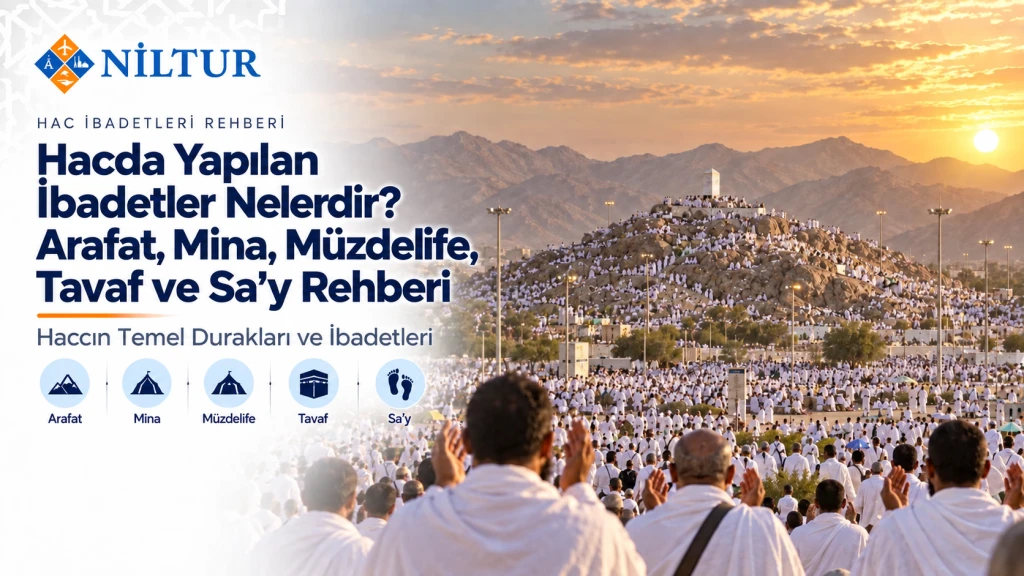
What is Arafat?
Arafat is one of the most important locations of Hajj.
For pilgrims to be present at Arafat within the designated time is called the Standing at Arafat (Wuquf at Arafat).
In the famous Hadith narrated from the Prophet Muhammad:
"Hajj is Arafat."
it was said. This narration is recorded as Sahih in Tirmidhi.
This short yet powerful statement highlights the central position of the Standing at Arafat within Hajj.
Why Is the Standing at Arafat So Important?
The day of Arafat is one of the most intense spiritual times of the Hajj journey.
At this place, pilgrims spend their time:
- Supplication (Dua)
- Repentance (Tawbah)
- Remembrance of Allah (Zikr)
- Recitation of the Quran
- Contemplation (Tafakkur)
- Seeking forgiveness
.
Arafat is a special time when a person distances themselves from daily life and re-evaluates their life, their servitude, and their turning towards their Lord.
Arafat in the Quran
Arafat is one of the Hajj locations explicitly mentioned in the Quran.
"Then depart from the place from where [all] the people depart and ask forgiveness of Allah..."
Surah Al-Baqarah, 2:198
This verse shows that the transition from Arafat to Muzdalifah is also a continuation of the Hajj worship involving the remembrance of Allah.
Where Do Pilgrims Go After Arafat?
After the Standing at Arafat, pilgrims move to Muzdalifah.
This transition is one of the most intensive stages of Hajj organization.
Because millions of pilgrims move simultaneously, it is of great importance not to rush, follow group order, and adhere to the guides' instructions.
Narrations also indicate that the Prophet Muhammad advised people to move calmly when departing from Arafat, highlighting the importance of tranquility during Hajj.
What is Muzdalifah?
Muzdalifah is the sacred area located between Arafat and Mina.
Pilgrims leaving Arafat stand here (perform Wuquf) and remember Allah.
The Quran's specific mention of Mash'ar al-Haram in Muzdalifah clearly demonstrates the importance of this location within Hajj rituals.
What Is Done in Muzdalifah?
In accordance with the Hajj program and jurisprudential practice in Muzdalifah:
- Standing (Wuquf)
- Remembrance (Zikr)
- Supplication (Dua)
- Prayer
- Preparation for Mina
are performed.
Stones for throwing at the Jamarat can also be collected here or from other suitable places.
During this process, it is especially important that elderly pilgrims do not leave the group order.
After Muzdalifah, Then Mina
The next important stop after Muzdalifah is Mina.
Pilgrims proceed to Mina according to the Hajj calendar and perform their relevant rituals, primarily the stoning of the Jamarat.
This stage is also one of the time-dependent sections of Hajj.
What Is Stoning the Devil?
Known in common language as "stoning the devil," this ritual involves throwing stones at the Jamarat in Mina on designated days.
This act of worship is explained with symbolic meanings recalling Hz. Ibrahim's submission to Allah and his stance against Satan's whispers.
For the pilgrim, throwing stones at the Jamarat is an important act of worship that also reminds them of being resolute against evil and sin.
Where Is Stoning Performed?
The ritual of throwing stones at the Jamarat is performed in designated areas in Mina.
Due to the intensity in the area during Hajj:
- Adhering to designated times
- Not leaving the group order
- Not rushing
- Being patient with other pilgrims
is important.
The warning in Surah Al-Baqarah 2:197 that "there is no quarreling" clearly shows that Hajj consists not only of rituals but also of good character.
Is Sacrifice Part of the Hajj Ritual?
Depending on the type of Hajj, the sacrifice ritual may be required.
Surah Al-Baqarah, verse 196, also addresses rulings on sacrifice in the context of Hajj and Umrah.
Since whether the sacrifice is necessary depends on the type of Hajj and the individual's conditions, guidance from religious officials should be followed in practice.
Shaving or Shortening Hair
After certain Hajj duties, men shave their hair or shorten it, while women shorten a portion of their hair.
This procedure is an important stage of exiting the state of Ihram.
Even these seemingly small practices in Hajj are performed within a specific sequence and sense of unity.
What Is the Visiting Tawaf?
The Visiting Tawaf (Tawaf al-Ifadah) is one of the fundamental Tawafs of Hajj.
Pilgrims come to the Masjid al-Haram at the appropriate time of the Hajj program and circle the Kaaba.
In the Diyanet's exegesis of Surah Al-Baqarah 2:197, it is stated that the Prophet Muhammad went to the Kaaba after the Jamarat, sacrifice, and shaving procedures during his Farewell Pilgrimage to perform Tawaf al-Ifadah, i.e., the Visiting Tawaf.
Why Is Order and Timing Important in Hajj Rituals?
Hajj is a worship tied to specific times.
The Standing at Arafat is the clearest example of this.
Therefore:
- Where one will be on which day
- When to enter Ihram
- When to move to Arafat
- Transitions between Muzdalifah and Mina
- The timing of Tawafs
- The schedule for stoning the Jamarat
must be known in advance.
The importance of professional guidance services in Hajj organization becomes fully apparent here.
Why Is Guidance Important During Hajj?
Knowing the Hajj rituals theoretically is important; however, the crowds, transportation, and timing processes in the holy lands require professional organization.
Experienced guides:
- Explain the rituals
- Inform about the daily schedule
- Identify meeting points
- Organize group movements
- Coordinate transitions between Arafat, Muzdalifah, and Mina
- Answer pilgrims' questions
Therefore, when selecting a Hajj program, attention should be paid not only to hotels and price but also to guidance and operational experience.
Why Is It Important to Learn the Prophet's Practice of Hajj?
One of the fundamental sources for the practical form of the Hajj ritual is the Prophet Muhammad's Farewell Pilgrimage.
While the Quran outlines the fundamental rulings, the implementation of the worship gained detail through the Sunnah of the Prophet Muhammad.
Therefore, in pre-Hajj education, along with verses, authentic Hadiths and the Prophet's Farewell Pilgrimage practice should also be learned.
Acceptable Hajj and Good Character
The spiritual nature of the Hajj ritual is not solely dependent on the formal performance of acts of worship.
The Prophet Muhammad said:
"Whoever performs Hajj for Allah and does not commit obscenity or sin returns free from sins as on the day his mother gave birth to him."
This Hadith is narrated in Sahih Al-Bukhari.
This Hadith strongly reminds that Hajj must lead to a change in a person's character and life.
Why Is Patience Important During Hajj?
During Hajj:
- Crowds
- Long waits
- Heat
- Walking
- Transport congestion
- Being together with people from different cultures
can test a person's patience.
The Quran's prohibition of arguing and turning to sin during Hajj clearly highlights the importance of patience in this worship.
The pilgrim must consider not only their own comfort but also the rights of other pilgrims.
How Should Spiritual Preparation Be Made for Hajj?
Hajj preparation should not consist only of packing luggage.
Before the journey:
- Hajj rituals should be learned
- Hajj verses in the Quran should be read
- Authentic Hadiths related to Hajj should be studied
- More emphasis should be placed on repentance and seeking forgiveness
- Reconciliation should be prioritized
- Consciousness should be raised regarding patience and good character
This preparation helps the pilgrim experience their worship in the holy lands more meaningfully.
Physical Preparation Before Hajj Is Also Important
Alongside spiritual preparation, physical preparation should not be neglected.
During Hajj, Tawaf, Sa'i, and movements between holy sites may require significant walking.
Therefore, it may be beneficial for the individual to engage in regular walking appropriate for their health condition before the trip.
Pilgrims with chronic illnesses or those who take regular medication should consult their own physicians.
Does Choosing a Nearby Hotel Facilitate Hajj Worship?
Selecting a hotel close to the Masjid al-Haram in Mecca can facilitate the daily worship schedule, especially.
Nearby accommodation:
- Can reduce travel time to the Haram
- Can reduce daily fatigue
- Can make returning to the hotel between prayers easier
- Can offer advantages to elderly pilgrims
However, it should not be forgotten that the physical intensity continues due to the stages of Mina, Arafat, and Muzdalifah in Hajj.
Is Medinah Visit Part of the Hajj Ritual?
The visit to Medinah is not one of the obligatory pillars (Rukun) of Hajj. However, a significant portion of Hajj programs includes accommodation in Medinah.
In Medinah, pilgrims:
- Visit the Prophet's Mosque (Masjid al-Nabawi)
- Visit Quba Mosque
- Visit the Uhud area
- Visit other historical and spiritual points included in the program
.
The Medinah visit is one of the extremely valuable spiritual parts of the journey to the holy lands.
The Goal of Hajj Is Not Just Completing Duties
One of the most striking emphases the Quran makes regarding Hajj is Taqwa (piety).
"Indeed, the best provision is fear of Allah (Taqwa)."
Surah Al-Baqarah, 2:197
Therefore, the goal of the Hajj journey is not merely going up to Arafat, performing Tawaf, or going to Mina.
These acts of worship are expected to strengthen the individual's:
- Loyalty to Allah
- Patience
- Good character
- Humility
- Sense of brotherhood
.
Hajj Journey with Niltur
Hajj organization is a comprehensive process far beyond flight and hotel reservations.
Especially:
- Accommodation in Mecca and Medinah
- Arafat
- Muzdalifah
- Mina
- Transfers
- Guidance
- Group coordination
must be planned in a compatible manner.
Niltur aims to provide an organizational understanding that, with over 30 years of Hajj organization experience, allows pilgrims to minimize their concern with operational details and focus on the spiritual aspects of their worship.
Frequently Asked Questions
What rituals are performed during Hajj?
Rituals such as Ihram, Tawaf, Sa'i, Standing at Arafat, Muzdalifah, Mina, stoning the Jamarat, and sacrifice (depending on the type of Hajj) are included within the Hajj rituals.
Which is the most important stage of Hajj?
The Standing at Arafat is one of the fundamental pillars of Hajj. It is narrated that the Prophet Muhammad said, "Hajj is Arafat."
Is Arafat mentioned in the Quran?
Yes. In Surah Al-Baqarah 2:198, the departure from Arafat and the remembrance of Allah at Mash'ar al-Haram are clearly specified.
Where do pilgrims go after Arafat?
After the Standing at Arafat, pilgrims proceed to Muzdalifah, and then according to the Hajj program, to Mina.
Where is stoning the devil performed?
Throwing stones at the Jamarat is performed in the Mina area.
Are Arafat, Mina, and Muzdalifah part of Umrah?
No. These are stages of the Hajj rituals. There is no Standing at Arafat, Standing at Muzdalifah, or stoning the Jamarat in Umrah.
Is Tawaf performed during Hajj?
Yes. Different Tawafs are performed during Hajj. The Visiting Tawaf is one of the fundamental rituals of Hajj.
Why is avoiding fighting and arguing important during Hajj?
The Quran explicitly prohibits turning to sin and arguing during Hajj. Therefore, patience and good character are important parts of the spiritual dimension of Hajj.
What is the spiritual goal of Hajj?
Hajj is a comprehensive act of worship aimed at strengthening the consciousness of servitude to Allah, repentance, piety, patience, and submission. The Quran's phrase "the best provision is Taqwa" powerfully summarizes this spiritual aspect.
Note: This content has been prepared for general informational purposes. Since there may be different rulings in the jurisprudential details of Hajj rituals depending on schools of thought and the individual's situation, the guidance of competent religious officials and official Hajj guidance should be followed in practice.